Four working prototypes on the RoRo platform: oncology, logistics, finance and security. Each one names the algorithm, the machine, and the exact price in credits. No hand-waving. And a fifth entry with no receipt at all — quantum-safe key exchange you can run free in your browser, plus the honest word on post-quantum cryptography.
Draw the circuit gate by gate in the visual builder, or write Python against the SDK. Diagram and QASM stay in sync; the ideal statevector can be scrubbed column by column before a single credit moves.
25 simulators and QPUs, each with qubits, technology and a public price per shot. The catalog is one list — our own processor and our partners' hardware behind the same codename scheme.
roro.submit_run(...) quotes first, holds credits on submit, settles when the machine answers and returns real counts. A machine-side failure refunds itself. Iterate free with roro.simulate().
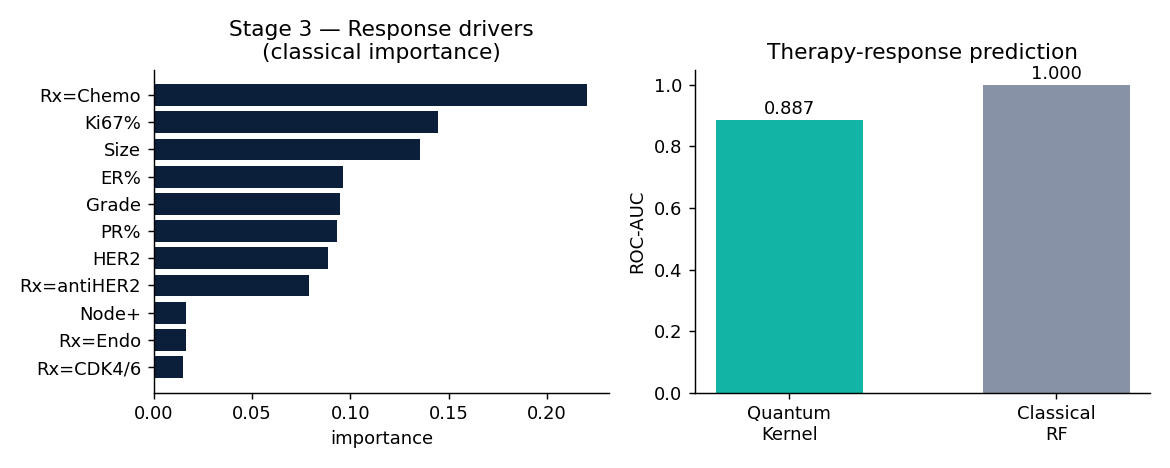
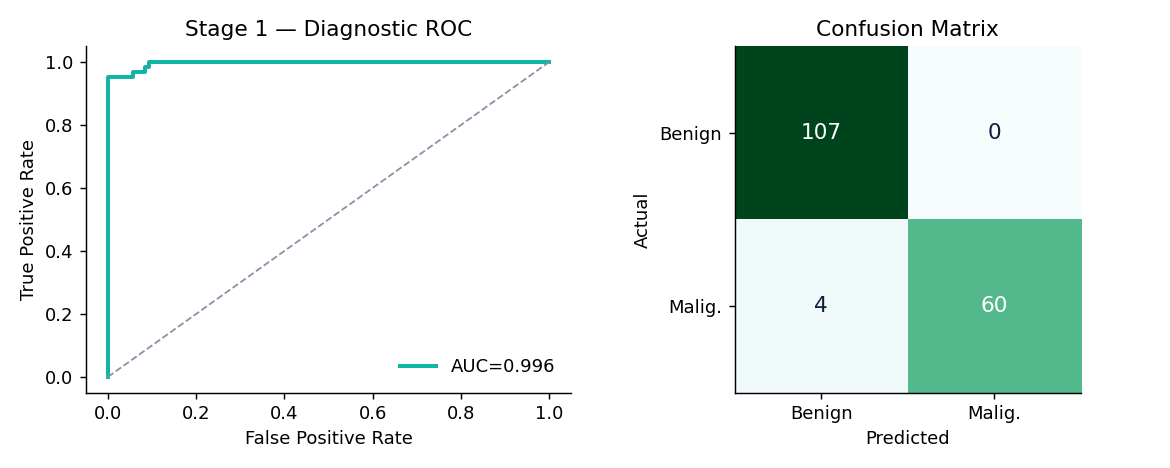
From 569 cases we diagnose malignancy, then predict whether a chosen therapy will work from pathology markers plus the drug — the part where getting it wrong costs a patient months.
A quantum kernel embeds each patient into a 264-dimensional state and measures similarity as quantum-state overlap — a feature space no classical kernel evaluates directly. On RoRo Quantum A1 the same map grows to 260 qubits' worth of state.
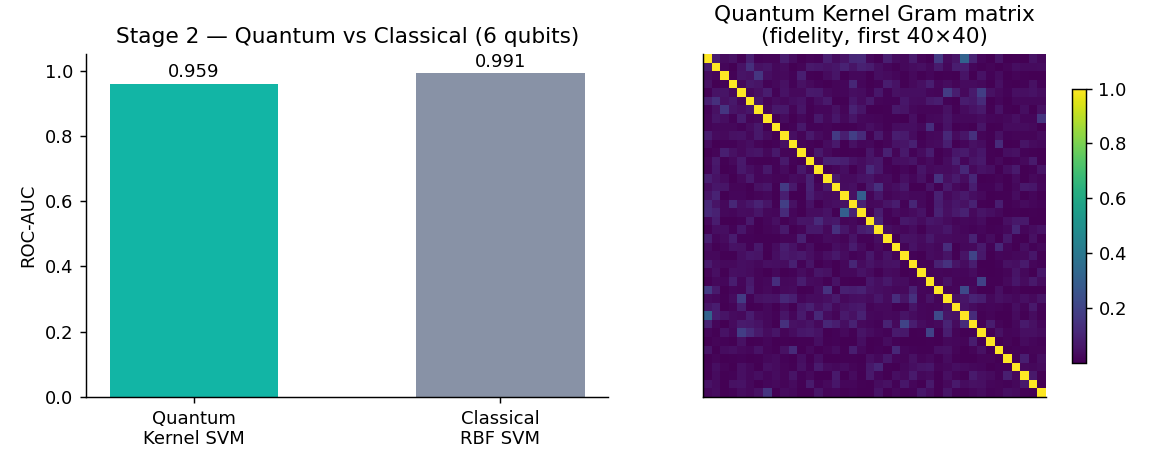
A random-forest classifier handles diagnosis — the mature, classical part. A fidelity quantum kernel (6 qubits, ZZ feature map) then powers an SVM for therapy-response prediction, computed as state overlaps and portable to a real QPU unchanged.


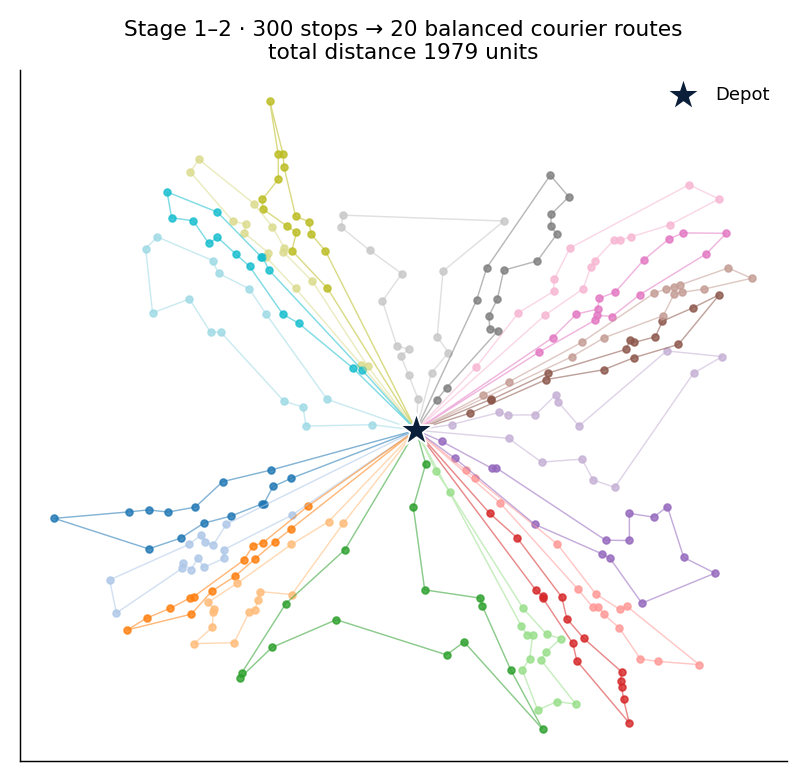
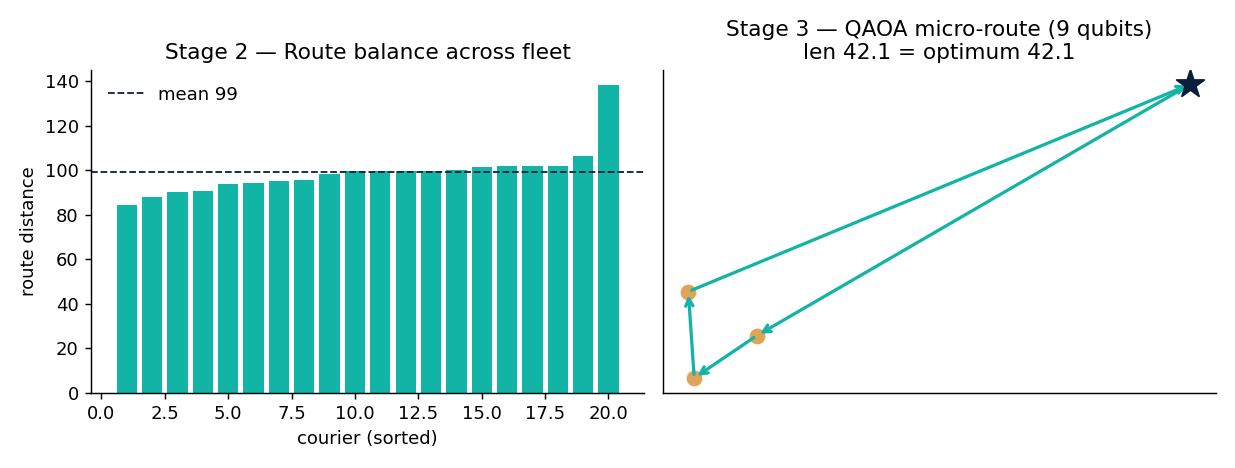
Route 300 deliveries across 20 couriers so every courier gets a fair, drivable day — minimising total distance without overloading anyone.
Assigning and ordering hundreds of stops is a combinatorial explosion — a 50-stop leg alone has more orderings than there are seconds since the Big Bang. Classical heuristics approximate; quantum solves small blocks exactly.
Classical sweep decomposition splits the map into 20 balanced regions and OR-Tools routes each — the production engine. One micro-route is then re-solved as a QUBO with QAOA (9 qubits), proving the QPU path on hardware-sized pieces.


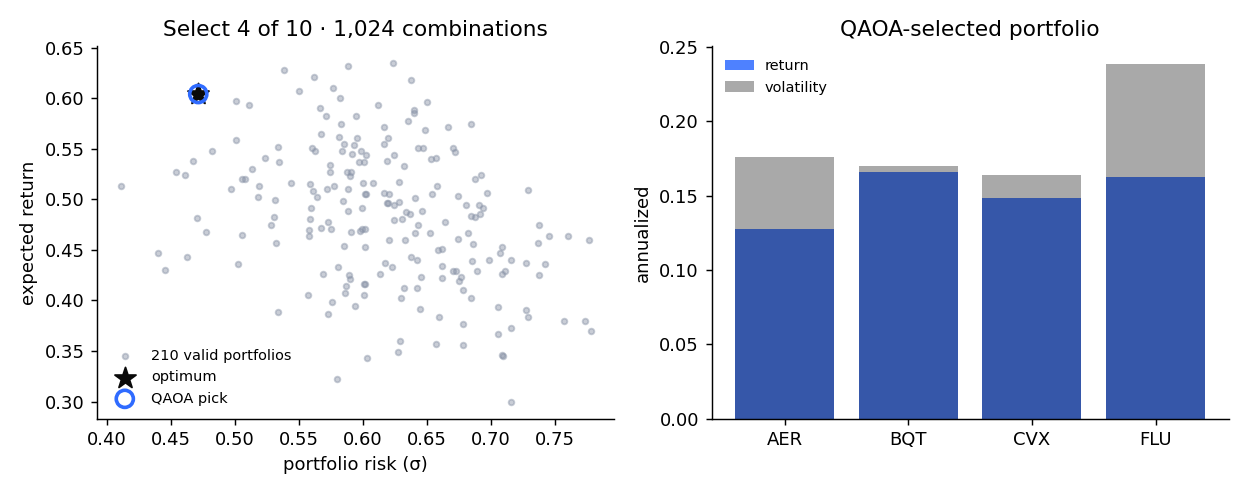
Choose 4 assets from 10 to maximise return for the risk taken — the classic mean-variance problem, as a hard combinatorial search.
With 10 assets there are 1,024 subsets; at 50 assets it is 250 ≈ 1015. Exhaustive search dies there. QAOA explores that space through interference instead of enumeration.
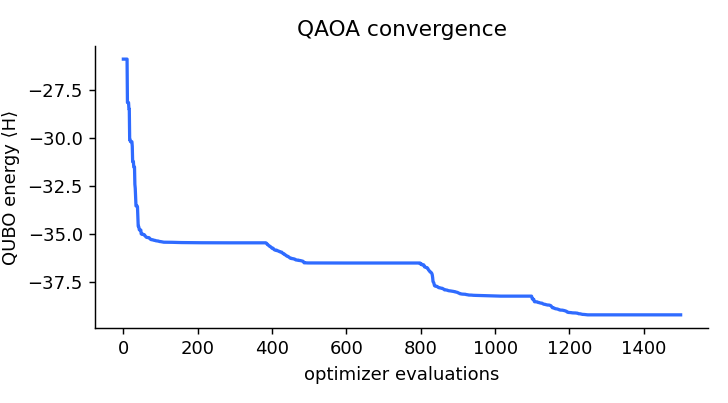
We encode Markowitz selection as a QUBO (return − risk penalty + cardinality) and solve it with QAOA on 10 qubits. Against brute force over all 1,024 portfolios, QAOA returned the exact optimum: AER, BQT, CVX, FLU.


Generate cryptographic entropy from physics — and show, on a real quantum register, the exact attack that will break today's RSA keys.
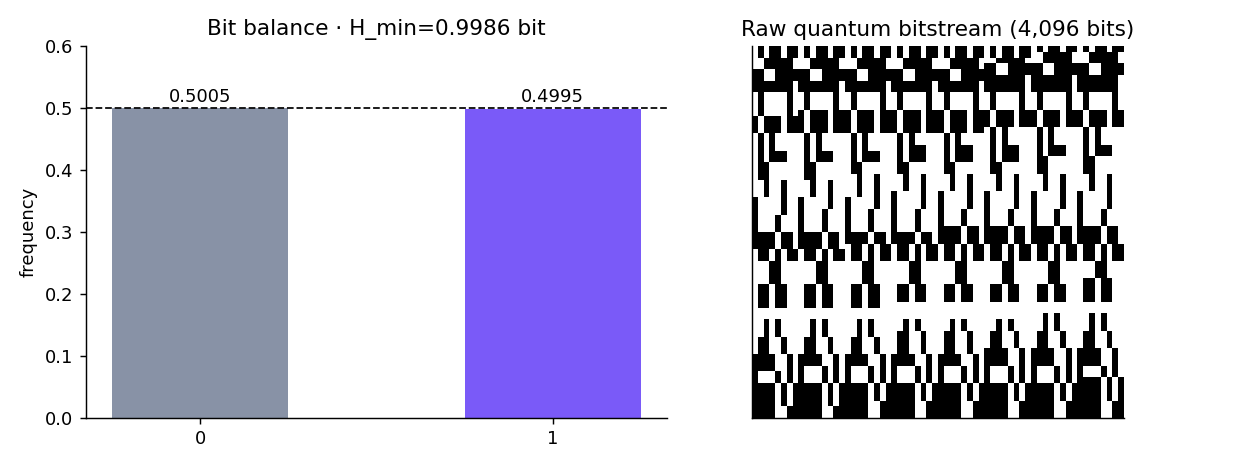
Classical RNGs are deterministic; quantum superposition is not. And Shor's algorithm turns factoring — the hardness RSA rests on — from billions of years into polynomial time. That is why post-quantum security exists now.
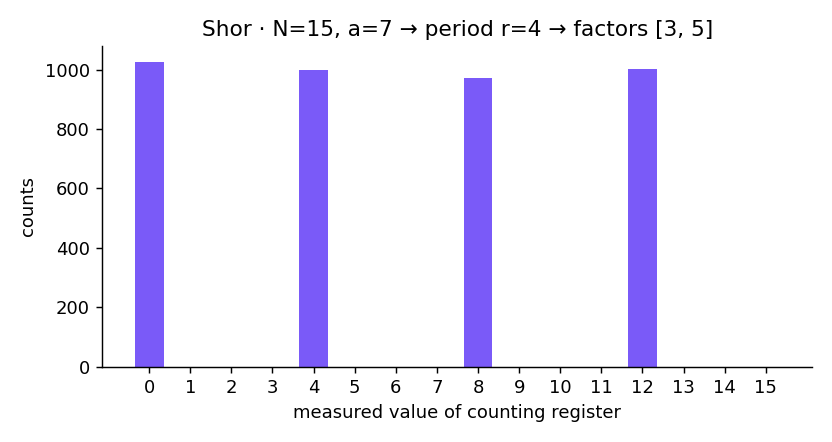
QRNG: 8 qubits in superposition yield 48,000 bits at min-entropy 0.9986/bit (NIST monobit p = 0.8266). Shor: on an 8-qubit register we factor N = 15 via period-finding — the interference peaks at 0/4/8/12 give period r = 4 → 15 = 3 × 5.


Prototype 04 is the attack. This entry is the defence — quantum key exchange you can run in your browser right now, free, and the post-quantum migration that runs on no quantum hardware at all.
In BB84, reading a qubit in flight disturbs it. On a clean channel the sifted key matches at both ends; an intercept-and-resend attacker drives the mismatch toward 25%. Security here means detection, not invisibility — and you can watch that number move.
BB84 key exchange, from our 48-item Lab library: encode, transmit, sift, and compare error rates with and without an eavesdropper — end to end on the free in-browser simulator. Alongside it, a PQC migration assessment: inventory, triage by data lifetime, hybrid roll-out, written verdict — built on NIST's final standards, ML-KEM (FIPS 203) and ML-DSA (FIPS 204).
Our own processor and our partners' hardware behind one submit_run() — whichever machine you name. Codenames are what the SDK takes; prices are the public per-shot rates.
Catalog snapshot from the live platform, August 2026. Availability changes hour to hour; a machine that is queued or in maintenance shows as busy. Orgs can carry negotiated pricing — the quote at submit is what binds.
We build the circuit, pick the machine, and submit — you watch the credits settle and the result come back. Then we tell you honestly whether quantum earns a place in your stack.