The canonical algorithms — runnable, measured, and honest about what they prove.

Phase estimation done the way today's hardware allows. An error-correcting code that shows you exactly the failure that defeats it. Amplitude estimation converging on π. Every program prints what it found and what that does not prove — because that second part is the education.
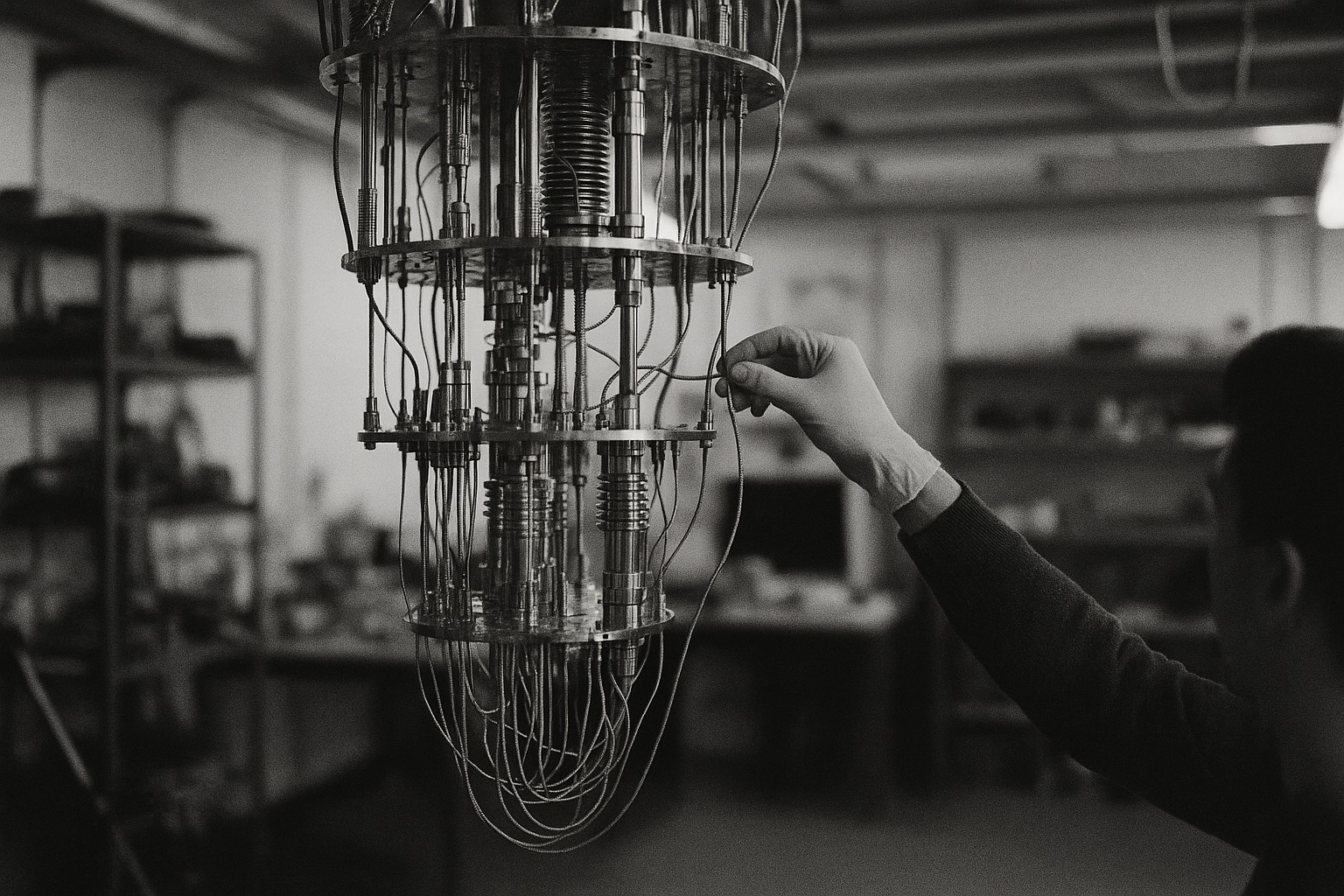
The lab is the lecture.
The problem, in your words

What actually hurts.

Courses without machines

Most quantum courses end at the whiteboard. Ours start where the whiteboard ends: every algorithm in the syllabus is a program students run, break, and modify in the browser — no install, no queue.

Papers without baselines

22 attributed reference implementations — licensed, imported, clearly marked read-only — give researchers a corpus to reproduce against, not just cite.

Intuition without honesty

The repetition code demo deliberately shows the double flip that defeats it. Negative results are curriculum here, not embarrassments.

How an engagement runs

Three steps. One written verdict.

01

Formulate

We map your syllabus or research question to library items and lessons — 24 of them, in Turkish and English, paired with runnable programs.

02

Run and measure

Students and researchers work in the browser lab with free simulation; real hardware is metered per shot with public prices when the experiment earns it.

03

Verdict in writing

For departments: a course plan with programs attached. For labs: which claims your instances can and cannot test on today's machines.

Proof, not projection

What we've already measured.

These programs are published in our algorithm library. The numbers below come from recorded executions we can reproduce on demand.

iterative-phase-estimation

Eigenphase readout one control qubit at a time.

Measured: Converges to the exact phase with hardware-realistic circuits.

repetition-code

The 3-qubit code, including the double flip that defeats it.

Measured: Shows both the correction working and the exact failure mode.

qmc-pi-estimation

Amplitude estimation converging on π.

Measured: The estimate tightens exactly as the theory predicts, shot by shot.

Results are from the library items' own recorded runs on our simulator — the same one your browser uses.

Where we draw the line

What we will not claim.

Education is the one domain where quantum computing over-delivers today — and we still keep the honesty rule: every program prints its own limitations next to its results.

  • Reference implementations stay attributed and read-only — foreign code never spends your credits silently.
  • Free simulation is genuinely free; hardware prices are public before the first shot.
Talk to us

Bring us your syllabus or your question.

Departments, labs, study groups — tell us what you teach or test, and an engineer (who has taught it) replies.

typically replies within a day — an engineer, not a script
Telecom & Networks All solutions Finance